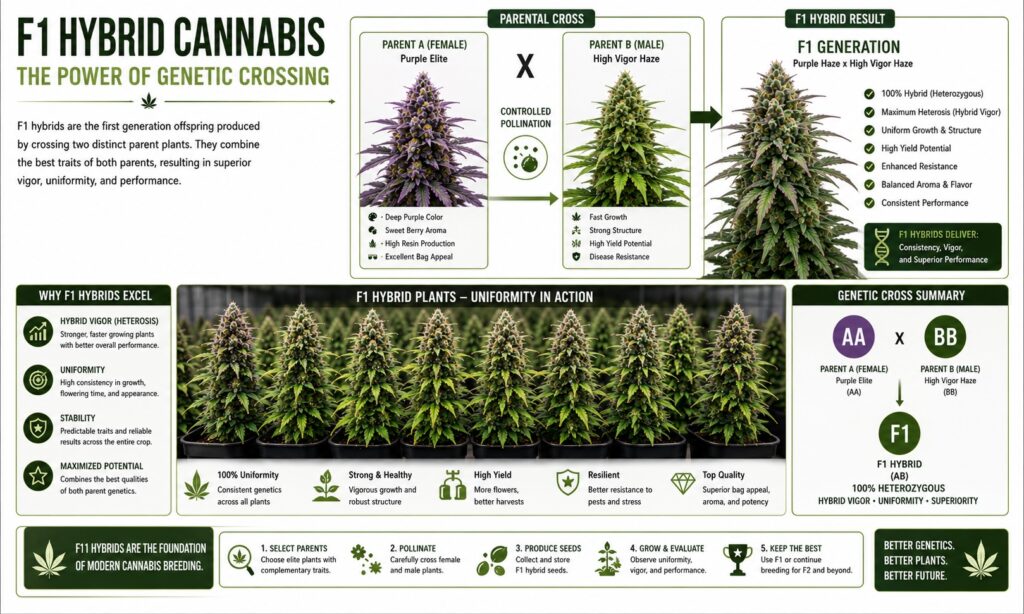
F1 hybrids have become an increasingly important topic in modern cannabis breeding. As breeding programs become more sophisticated and growers seek greater consistency, many cultivators are paying closer attention to the advantages offered by first-generation hybrid genetics. Although the term F1 hybrid is widely used throughout agriculture, its meaning is not always fully understood within the cannabis community.
An F1 hybrid is the first generation produced by crossing two distinct and carefully selected parent lines. When developed properly, these hybrids can display a combination of desirable traits inherited from both parents. Understanding how F1 hybrids are created and why they are valued helps growers make more informed decisions when selecting genetics for cultivation projects.
What Is an F1 Hybrid?
The term F1 stands for “first filial generation.” In cannabis breeding, it refers to the offspring resulting from a cross between two separate parent lines. These parent lines are typically selected because they possess specific characteristics that breeders want to combine within a single cultivar.
When two carefully chosen parent plants are crossed, the resulting offspring may display a high degree of vigor and uniformity. This phenomenon is often associated with hybrid breeding and is one reason why F1 hybrids attract significant attention from breeders and growers alike.
The quality of an F1 hybrid depends heavily on the quality and stability of the parent lines used to create it.
Strong parent genetics remain the foundation of successful hybrid development.
Why Breeders Create F1 Hybrids
Breeders use F1 hybrids to combine desirable characteristics from different genetic backgrounds. One parent may contribute strong structure and adaptability, while another may offer stability, vigor, or unique aromatic characteristics. The goal is to create offspring that benefit from the strengths of both lines.
This approach allows breeders to explore new genetic combinations while maintaining a structured breeding strategy. By selecting parents carefully, breeders can increase the likelihood of producing offspring that meet specific objectives.
F1 hybrids often serve as an important starting point for future breeding projects and cultivar development.
They provide valuable opportunities for both innovation and genetic improvement.
Uniformity and Hybrid Vigor
One of the most commonly discussed advantages of F1 hybrids is their potential for uniformity. When parent lines are sufficiently stable, the resulting offspring may display similar growth patterns, development rates, and overall characteristics.
Growers often appreciate this consistency because it can simplify cultivation management and improve predictability throughout the growing cycle. Uniform populations are generally easier to evaluate and manage than highly variable ones.
Another potential advantage is hybrid vigor, sometimes referred to as heterosis. This phenomenon may result in offspring that demonstrate strong growth and overall performance compared to their parent lines.
While results can vary depending on the genetics involved, hybrid vigor remains one of the primary reasons breeders continue exploring F1 breeding projects.
The Role of F1 Hybrids in Modern Cannabis Genetics
As cannabis breeding continues evolving, F1 hybrids play an increasingly important role in the development of new cultivars. Many breeding programs use hybridization as a way to introduce diversity while maintaining clear breeding objectives.
Growers interested in exploring modern cannabis genetics can learn more through https://www.ministryofcannabis.com/fr/graines-cannabis-feminisees/. Understanding breeding concepts such as F1 hybrids helps cultivators better evaluate available genetics and appreciate the work involved in cultivar development.
Hybrid breeding has contributed significantly to the diversity of modern cannabis cultivars.
Many contemporary genetics trace their origins to carefully planned hybridization projects.
Future Opportunities in Hybrid Breeding
Advances in plant science, genetic analysis, and breeding techniques continue creating new opportunities for hybrid development. Breeders now have access to more information and more diverse genetic resources than ever before.
These tools help support more informed breeding decisions and improve the efficiency of cultivar development. As the cannabis industry matures, interest in structured breeding approaches is likely to continue growing.
Additional information regarding legislation and cannabis industry topics can be explored through https://lacremeducbd.fr/blog/legislation.
The future of cannabis breeding will likely include an even greater emphasis on stability, consistency, and carefully developed hybrid genetics.
Final Thoughts
F1 hybrids represent an important component of modern cannabis breeding. By combining carefully selected parent lines, breeders can create offspring that display desirable characteristics, improved uniformity, and strong cultivation potential.
Understanding how F1 hybrids are developed helps growers appreciate the science and planning behind modern genetics. As breeding programs continue advancing, F1 hybrids will remain a valuable tool for innovation, genetic improvement, and the ongoing evolution of cannabis cultivation.